PixVerse AI Review 2026: AI Video Generator, Features, Pricing & More
Introduction
PixVerse AI is an AI-powered video creation tool that enables users to make compelling films using basic text prompts, photos and creative ideas. The PixVerse AI video generator does both text-to-video and picture-to-video, so you can take a written notion or still image and transform it into a short film made by AI, and you don’t need to know how to edit videos the usual way. It also includes tools for content makers, marketers, social media users or anybody exploring AI video, such as creative tools and generation features. Users may access free and premium services with varying use limitations and capabilities based on the plan. In this PixVerse AI review 2026, we will discuss how PixVerse AI video generation works, its main features, image-to-video and text-to-video capabilities, pricing, the free plan, video quality, ease of use, limitations, and alternatives to help you decide if PixVerse AI is good for your video creation needs.
What Is PixVerse AI?
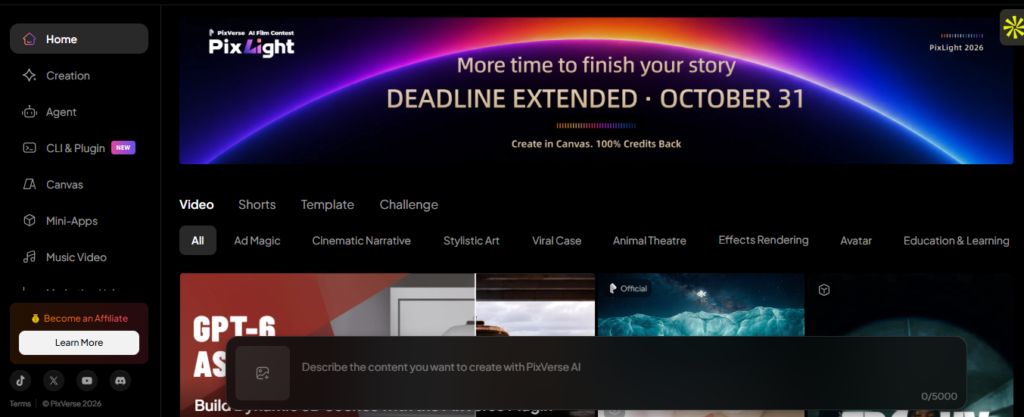
PixVerse AI is an AI-powered creative platform that generates films from text prompts, photos, and other creative inputs. It’s an AI movie generator where users may provide a description of a scene, movement, character or visual idea and transform that notion into an AI-generated film. PixVerse AI video solutions let designers bring static ideas or pictures to life using text-to-video and image-to-video processes without needing significant video-editing abilities. Its PixVerse AI capabilities are designed to serve a wide variety of customers including content makers, marketers, social media creators, designers, and enterprises wanting to generate compelling visual material more effectively. The platform is ideal for short-form social media material, creative ideas, promotional imagery, and other AI-created video projects.
How Does PixVerse AI Work?
PixVerse AI takes a creative concept from a user and uses AI models to generate a movie from it. Depending on the available generating option, you may provide a written prompt or an image, describe the scenario and desired motion, tweak the available parameters and make a movie.
A basic PixVerse AI process looks like this: Idea > Prompt/Image > Settings > Generate > Review > Edit > Export.
The finished outcome may differ based on the question, input picture, chosen parameters and the sort of movement or visual elements needed.
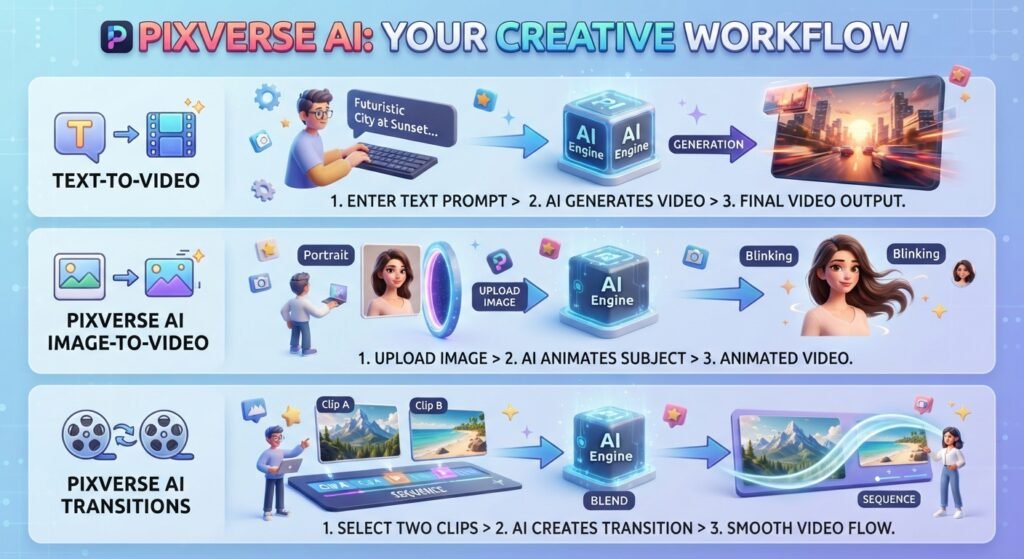
1.PixVerse AI Text-to-Video
PixVerse AI text-to-video lets users express a video concept in natural language and make a movie from that description. Rather of having to create every scene yourself, you can just put in the prompt what the subject is , what they are doing, the surroundings, how the camera is moving, the lighting, and the visual style. For example, a suggestion may be a cinematic shot of a vehicle traveling through a wet city at nite, with the necessary camera movement and mood.
The better prompt, the better AI understands the scenario. You may use short prompts for basic notions, or more extensive questions that provide more information about the topic, movement, composition and style. But mixing in a lot of contradictory instructions might make the outcome less predictable. For best results, define the topic, action, surroundings, camera movement and visual style clearly and keep the directions constant.
2.PixVerse AI Image-to-Video
PixVerse AI picture to video enables users to convert a static image into an animated video. Rather of creating the whole visual from a written description, the uploaded picture gives the beginning point and motion directions may be utilized to specify how the scene or subject should move.
You may submit a shot of a person standing on a street and say a mild camera push-in, for example, with the individual’s hair blowing in the breeze. The quality and composition of the source photograph might impact the final effect; thus, clear, high-quality photos with a clearly defined topic often make for a better starting point. Picture-to-video is especially beneficial when you want to keep the base appearance of an existing picture but add motion and create a more dynamic clip.
3.PixVerse AI Transitions
You may create movement across various areas of a movie or link visual elements using creative effects. The available transitions or effects in PixVerse AI may vary as the platform updates its functionality. You should check its current interface and official documentation to see which tools are now accessible and supported.
When you use a transition or creative effect, evaluate how the beginning and ending images relate to each other. The more similar the themes, compositions or visual styles, the more natural the change will seem, while more diverse photographs will tend to provide a more obvious or experimental effect. Therefore, the quality of the transition depends not only on the chosen effect, but also on the pictures or scenes that are to be linked.
The fundamental methodology for the PixVerse AI video generator is rather simple overall: you start with a concept, give it a prompt or picture, set up the choices it has available, produce the clip, see how it came out, and make any adjustments you want. This makes PixVerse AI perfect for those interested in experimenting with AI-generated video but do not want to create each scene with typical video-editing applications.
PixVerse AI Video Generator Features
PixVerse AI combines text questions, graphics, generation parameters and creative controls to enable users to produce AI-generated movies for many sorts of visual projects. The current V6 model has text-to-video and image-to-video with native audio, multi-shot generation, first/last-frame transitions, video extension and reference-based video workflows. Users may also affect video length, resolution, aspect ratio, and other generating characteristics, depending on the creation mode.
1.AI Video Generation
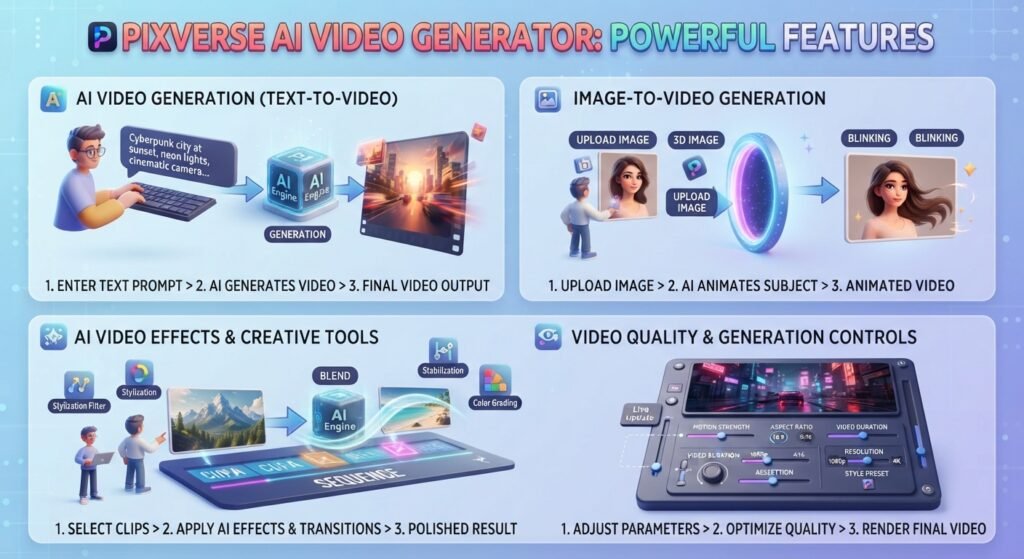
The PixVerse AI movie generator allows you to make an AI video based on a textual idea using text-to-video generation. The user supplies a prompt that defines the scenario they desire, describing the topic, surroundings, movement, camera orientation, lighting and visual style. According to the PixVerse literature, the more explicit the query, the better the model can grasp the scene and movements you are trying to describe.
PixVerse AI video creation allows users to build scenes for social media material, creative ideas, marketing images, product campaigns, narrative and other short-form video projects. The newest V6 version can generate video from 1 second to 15 seconds, and output quality from 360p to 1080p.
2.Image-to-Video Generation
PixVerse AI picture-to-video lets users to make a movie by animating an existing image, instead of generating the visual from a written description. The picture represents the visual beginning point. A prompt and accessible controls may be used to indicate the intended movement or camera behavior. At this time, V6 is supported for image-to-video production in PixVerse documentation. It contains settings such as duration, quality, motion mode, camera movement and prompts.
This approach is helpful if you have a product picture, character design, photograph, illustration or other visual asset that you want to bring to life with motion. For the best possible outcomes, the first picture should clearly show a topic and composition, and the prompt should describe the desired movement instead than excessively explaining elements that can be seen in the image. PixVerse also suggests utilizing clear visual references and when necessary indicate camera motions such as push-in, pan, tilt, tracking shot or orbit.
3.AI Video Effects & Creative Tools
PixVerse offers creative production capabilities beyond simple text-to-video and image-to-video conversion. The current V6 documentation lists available features as: first/last-frame transitions, video extension, reference-to-video, native audio, multi-shot creation. Instead of seeing each created clip as an individual video, these tools may assist users construct more organized sequences.
For example, first/last-frame generation generates a transition between two visual states and video extension continues a given clip. Reference-to-video utilizes visual cues to direct the output result. Note that the actual controls accessible may vary according on the chosen model and creation method; thus users should verify the current PixVerse interface before depending on a particular option.
4.Prompt-Based Video Creation
The process of prompt-based production is an integral feature of the PixVerse AI video generator operation. Rather than just identifying an item or scene, users may specify how they want the scenario to appear and move.
- A good prompt can include:
- Subject: What should be included in the video
- Movement: What the subject must do
- Camera: How the camera should move or frame the scene.
- Environment: Where the scene is situated
- Illumination: Preferred illumination or time of day
- Style: How it is supposed to look or feel
- Audio: Details of conversation, sound effects or ambiance where supported
PixVerse’s official text-to-video guideline encourages using explicit and descriptive suggestions, noting that setting, movement, lighting, and ambiance are helpful aspects. Its current V6 materials also stress camera movement, visual style, character behavior, music and sequence organization.
5.Video Quality and Generation Controls
PixVerse includes a number of controls that impact the generation of a video. Current V6 documentation has a 360p, 540p, 720p and 1080p output quality with video lengths ranging from 1 to 15 seconds. Supported aspect ratios include the usual 16:9, 9:16, 1:1, 4:3, 3:4, 2:3, 3:2 and 21:9 in relevant generating modes.
The accessible controls might depend on the generating mode. For example, V6 enables aspect-ratio option for text-to-video, whereas certain image-to-video and transition operations have distinct parameters available. Native audio creation and multi-clip generation for supported V6 workflows are likewise tracked by the platform.
Choosing the proper settings depends on the usage. The 9:16 format may work well for vertical short-form footage, but 16:9 is often utilized for landscape video. Higher resolution may give more detail but may also cost more credits, thus the optimal option depends on the quality needed, the length of time, and the budget for generation. In PixVerse’s current V6 API docs, you can see that the amount of credit used depends on the resolution and audio parameters.
PixVerse AI Use Cases
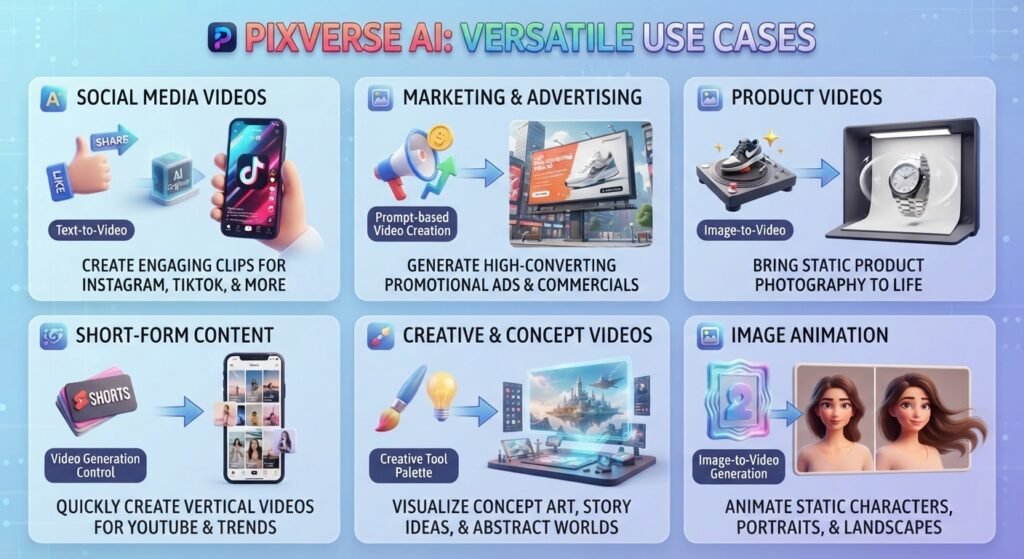
PixVerse AI is not only for making short AI video. Its text-to-video, image-to-video, multi-shot, audio and creative processes may enable social content, marketing campaigns, product promotion, narrative and visual experimentation. The optimal use case depends on what kind of material you want to make, what assets you have on hand, and how much control you want over the finished film.
1.Social Media Videos
PixVerse can assist producers in turning ideas, photos and short concepts into ready-to-go videos on social platforms. Vertical formats like 9:16 may be helpful for mobile-first content, and capabilities like image-to-video and native audio can assist make more dynamic clips from current visual assets. That makes it a valuable platform for social posts, reels, short promotional films, creator material and visual hooks that can be used across media.
An effective method for creators is to start out with a basic concept or existing picture, develop many visual variants, assess the results and improve the version that best matches the desired audience and platform. The resulting video still has to be checked for visual quality, text positioning, audio and platform-specific criteria before it is published.
2.Marketing & Advertising
You can also use PixVerse to create marketing films and advertising creatives. Current capabilities include product promotion processes, social campaigns, brand material, and ad ideas. PixVerse’s Ad Master and Marketing Hub are intended to convert product assets, scripts, hooks, or campaign concepts into video advertisements and other promotional material.
This might be handy for marketers when there’s a requirement to test many creative approaches. Instead of doing a standard shoot for every variant, a team might come up with new hooks, visual treatments, or product scenarios from the same campaign concept. But created advertisements must be vetted for product accuracy, claims, branding, copyright and platform compliance before they are released. PixVerse itself advises human inspection as part of the advertising procedure.
3.Product Videos
Another practical use of PixVerse is product videos. Businesses may employ image to video creation on product shots or other current images to add camera movement, environmental motion or a more theatrical presentation. In particular, PixVerse is presented as a launchpad for developing motion-based video using product shots, marketing stills and brand assets.
This is handy for ecommerce sites, product launches, landing pages, social marketing and promotional efforts. For example, a picture of a product may be transformed into a short film with a controlled camera push, product reveal, lifestyle setting or other motion direction. Careful verification of the resulting product is necessary to ensure that the form, packaging, colors and other critical features of the product stay correct.
4.Short-Form Content
AI video production is a good match for short-form video since artists generally want various visual concepts without having to create every clip from scratch. The PixVerse V6 allows 1 to 15-second videos in a variety of formats, including vertical and landscape aspect ratios. This enables the creation of small clips to suit diverse distribution demands.
Creators may use this pipeline for short tales, visual hooks, cinematic moments, instructive bits, campaign teasers and other short-form content. Multi-shot creation may also provide additional structure to concepts that need many linked shots rather than one continuous scene.
5.Creative & Concept Videos
PixVerse may be beneficial early in the creative creation process, particularly when a creator or team wishes to visualize a concept before committing to the production of a whole project. Text-to-video may sketch a textual scenario visually, whereas picture-to-video can animate an existing idea, character design, product image or reference frame.
So it is well suited for concept creation, cinematic experimentation, narrative concepts, character scenarios, visual prototypes and creative pitches. Creators may utilize the created clip as a tool to explore composition, camera movement, mood, and the direction of narrative rather than directly using it as the finished creation.
6.Image Animation
If you already have a finalized graphic, one of the easier ways to utilize PixVerse is via mage animation. You may use a picture, an illustration, a product shot, a portrait, or a concept image as the basis for an animated scenario. Users may specify the required movement, such as a slow camera push, revelation, environmental motion or other visual activity and create a film around the original picture.
This method is especially handy when the visual design is complete but requires motion for social media, presentations, advertising, product sites or creative tasks. The quality of the first picture is important, as the resulting animation is based on the initial composition.
How to Use PixVerse AI
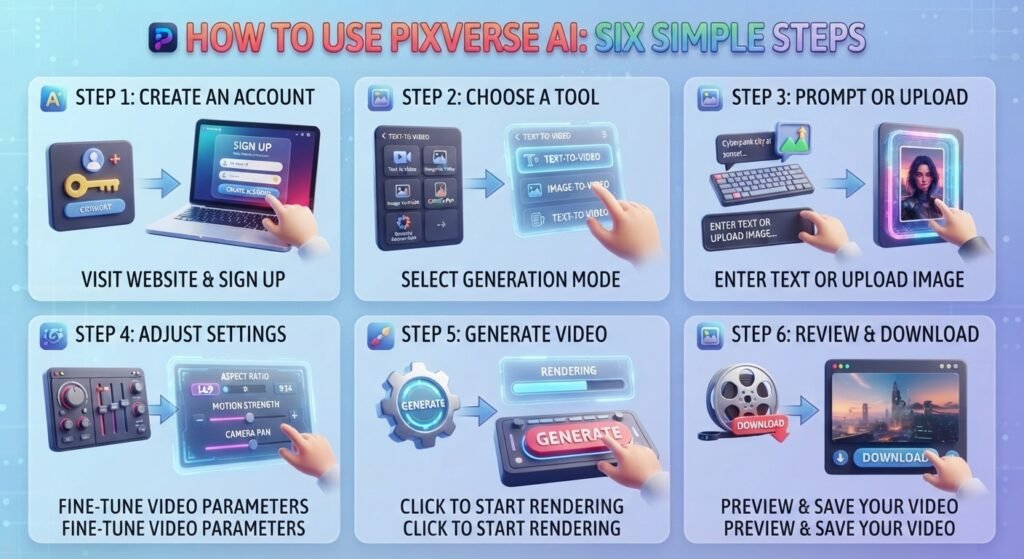
PixVerse AI needs a way to make a movie: a prompt or an uploaded picture, settings adjustments (if necessary), video production, and a check of the outcome. Here’s a brief tutorial on how to utilize PixVerse AI.
Step 1: Create a PixVerse AI Account
Head to PixVerse and register an account with the given PixVerse AI sign-up option. After registration, log in to the generation workspace using the PixVerse AI option.
Step 2: Choose a Video Generation Tool
Choose the process you require, such as text-to-video or image-to-video. Use text-to-video when you have a concept, or image-to-video when you already have a picture.
Step 3: Enter a Prompt or Upload an Image
Write a specific prompt about the topic, action, surroundings, camera movement and style. For picture-to-video, post your image and specify the motion you want included.
Step 4: Adjust Video Settings
Look at the choices for time, resolution, aspect ratio, motion and other generation settings. Select options depending on what kind of video you want to make.
Step 5: Generate Your Video
Click on the generation choice and let PixVerse process your prompt/image If it’s not what you’re thinking, adjust the question or settings, and try again.
Step 6: Review and Download the Result
Check the resulting video for visual quality, motion, consistency, and other critical characteristics. If you’re happy with it, click Export or Download if there is one.
Is PixVerse AI Free?
Yes, PixVerse AI is free to use, however there are use constraints for the free version. PixVerse now offers daily credits for video production, with subscription plans offering more credits, greater quality, and extra features. Currently, as per PixVerse, free users are entitled to get daily credits, although the actual amount and features offered may vary over time.
1.What Does the PixVerse AI Free Plan Include?
The free edition allows consumers to experience AI video creation by PixVerse without committing to a subscription plan immediately. PixVerse now gives daily credits that you utilize when you create videos. The official FAQ indicates that daily credits are reset at 00:00 UTC and any unused daily credits expire at the end of the day.
Today’s price page has a Basic tier with 30 credits per day and video output up to 540p. Paid plans enhance the available credits and might provide better resolution creation depending on the plan.
2.PixVerse AI Free Limits
The free version of PixVerse AI just limits the generation quantity that comes from daily credits. The quantity of credits per video varies based on the chosen model, quality, length, audio and other creation options. PixVerse indicates the amount of credit necessary before creation.
- Other limitations may include
- Free access is restricted by a daily amount of credits.
- Resolution: Basic tier currently shows video up to 540p.
- Generation Cost: Longer or better quality videos may cost more credits.
- Premium features: Some higher-end models and features are accessible via premium programs.
- Unused credits: Credits expire daily vs roll over.
Watermark and other export limitations may depend on the product process and current goal. Current premium plans of PixVerse advertize watermark-free and ad-free creation, thus users should examine the plan specifications for precise limitations that apply to free output.
3.Can You Use PixVerse AI for Free?
Yes. There are daily free credits, so you don’t have to pay for PixVerse AI. The free access is good for checking out text-to-video, image-to-video, and other supported generation procedures, but how many videos you can generate depends on how many credits each generation costs.
PixVerse also provides paid membership options if you require frequent generations, greater quality, more credits, or more premium features. PixVerse changes its prices, models, and credits system often, so it’s a good idea to check the official pricing site before making a purchase.
PixVerse AI Pricing
PixVerse AI offers a free Basic plan and many premium membership options. Most users have the choice between monthly or annual payment. The current pricing page shows a lower effective monthly price for annual billing. Credits, video quality, creation speed and accessible features vary by plan.
| Plan | Monthly | Yearly* | Credits | Video Resolution | Main Features |
| Basic | Free | Free | 30 daily credits | Up to 540p | Basic PixVerse access |
| Standard | $10/month | $8/month | 60 daily + 1,200/month | Up to 720p | Watermark-free, faster generation, 3 concurrent generations |
| Pro | $30/month | $24/month | 60 daily + 6,000/month | Up to 4K | 5 concurrent generations, batch creation, additional model access |
| Premium | $60/month | $48/month | 60 daily + 15,000/month | Up to 4K | 8 concurrent generations, additional premium benefits |
| Ultra | $249/month | $149/month | 60 daily + 25,000/month | Up to 4K | 8 concurrent generations and premium benefits |
Annual pricing reflects the actual monthly amount when invoiced yearly. PixVerse price, credits, models, and features are subject to change. For the latest numbers, please visit the official PixVerse pricing page.
PixVerse also has additional credit packs for those who require increased generating capacity but don’t necessarily want to move up to a higher membership tier.
1.Is PixVerse AI Worth Paying For?
It is contingent upon how you use it:
Casual users: Test PixVerse with the free plan.
Content creators: If you’re running out of free credits, a premium plan might be handy.
Heavy users: Higher credit plans have higher generating capacity.
Business: Higher resolution, quicker production, and other attributes may be more useful to business processes.
Before subscribing, be sure to check out how many videos you intend to generate each month vs. how many credits you’ll get with each plan. This will offer you a better understanding of the PixVerse AI pricing and your possible cost per useful footage.
PixVerse AI Video Examples & Quality
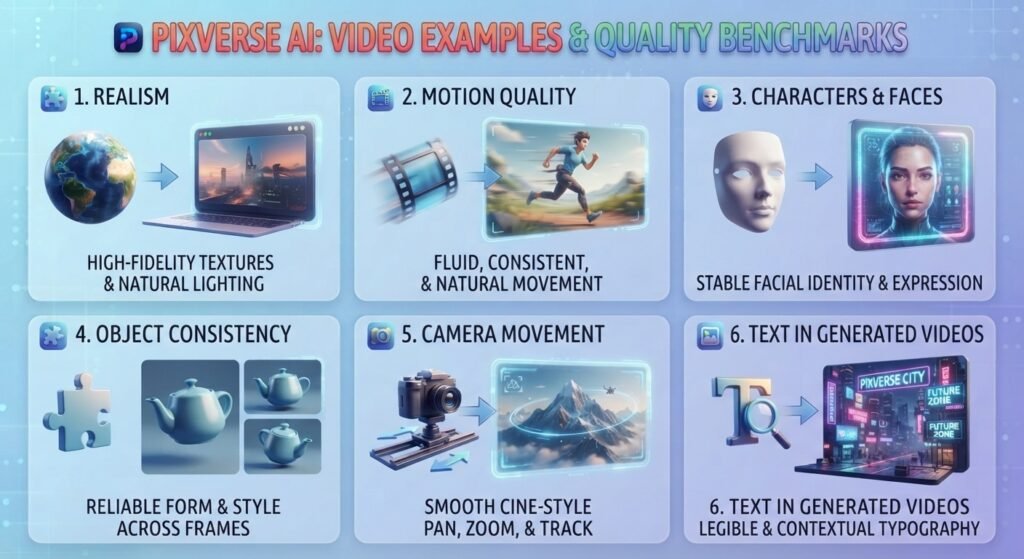
The quality of a PixVerse AI film may vary based on the model, prompt, source picture, generation parameters, and the intricacy of the scenario. If you’re looking at samples of PixVerse AI video, it’s helpful to go a little further than the general appearance to things like realism, motion, character consistency, camera movement and text display.
1.Realism
Motion is a fundamental aspect of AI video production. PixVerse can animate people and objects, surroundings and camera moves – but the quality depends on the motion you want. Scenes with several complicated actions happening at once are usually harder for an AI model to imitate than simple and well-defined motions.
2: Motion Quality
PixVerse is capable of creating animated characters and situations with a focus on humans, although faces and body features still need to be carefully examined. Fast motion, odd positions, several characters or complex interactions may occasionally lead to discrepancies between frames.
3: Characters & Faces
Item consistency means that an item continues to look the same while the video goes on. This is especially true for product videos, personalities, and branded graphics. A clear source picture and a well-defined prompt might assist but material created by AI may still alter forms, textures, colors or tiny details.
4: Object Consistency
Camera movement may have a big impact on how cinematic a created video seems. Depending on the chosen process, users may define actions such as pan, tilt, tracking, zoom, push-in, or orbit in their prompts, or use accessible camera controls. Explicit instructions about the camera might assist the model to understand how the scene should be shown.
5: Camera Movement
AI video models usually struggle harder to find text than other visual features. The generated text may look twisted, misspelled or inconsistent across frames, especially if there is a lot of text in a scene. When dealing with ads, product labels, logos, or essential on-screen information, it’s best to thoroughly analyze the output and make any required additions or corrections to crucial language in post-production.
6: Text in Generated Videos
PixVerse may provide helpful outputs for social media clips, creative ideas, product images, marketing material, and short-form movies; however, the quality of the output is not consistent for every challenge. The best outcomes will rely on the model, input quality, prompt clarity, motion complexity, and generation parameters. To get a good idea, try several situations, rather than rating the platform on one
PixVerse AI Video Examples & Quality
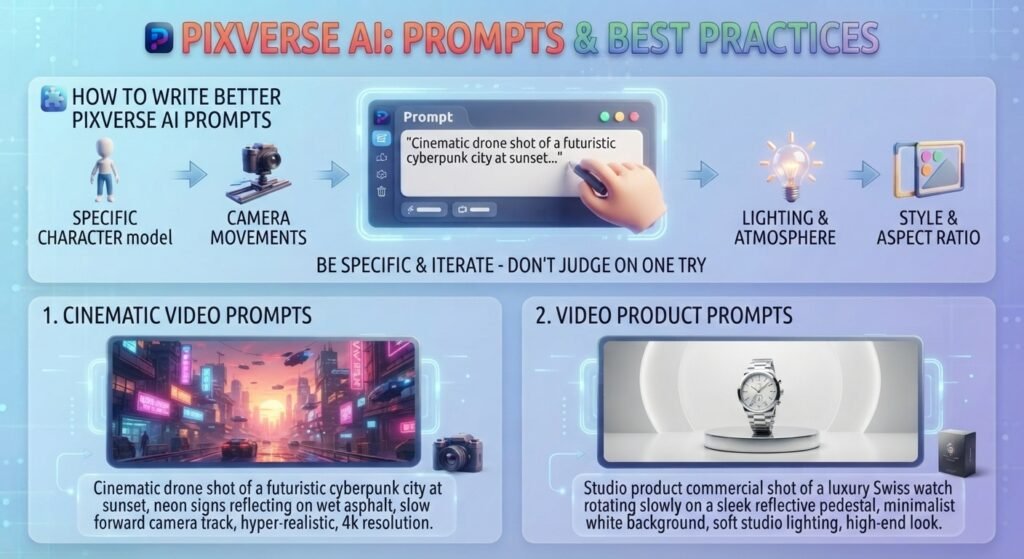
Good prompts assist PixVerse understand better the topic, action, environment, camera movement and visual style you want to create. Don’t just write a few generic words; write out the crucial pieces of the scenario clearly and consistently. Below are several PixVerse AI prompts that you may customize for varied video creation purposes.
1: How to Write Better PixVerse AI Prompts
A simple formula for creating a detailed prompt is:
Subject + Action + Environment + Camera + Lighting + Style + Motion
For example:
Virtual sports vehicle traveling through a rainy metropolis at nite, neon lights reflecting off the wet road, slow tracking camera, dramatic lighting, realistic style, fluid motion.
This framework offers PixVerse context on what has to be there, what it needs to accomplish, where the scene is, and how the camera and visual style should look. Don’t provide contradictory directions and concentrate on the most critical visual features.
2.PixVerse AI Prompt Examples
1.Cinematic Video
One astronaut walks over an unknown planet at twilight, dust blowing in the air, slow cinematic camera push-in, dramatic lighting, realistic cinematic style, smooth natural motion.
2.Video Product
Premium black smartwatch revolving slowly on a clean reflecting surface, soft studio lighting, close-up camera movement, luxury commercial style, genuine product details, smooth motion.
Is PixVerse AI Safe?
Finally, PixVerse AI is a video-generation platform with proven privacy and security precautions, but users should not assume that any online service is without danger. PixVerse asserts it employs security procedures like encrypted data transfer and management of access to secure user information. The platform also states that its information security management system is ISO/IEC 27001 certified and has SOC 2 controls. If you’re creating often, how safely you can use PixVerse AI depends on what you submit and how you maintain your account. Please take a moment to check the current privacy rules of the site and feel comfortable with the handling of the data before contributing extremely sensitive or personal photographs and information.
Is PixVerse AI Free for Commercial Use?
Not quite. Under PixVerse’s current Terms of Service, free/non-commercial usage does not automatically provide commercial-use rights for created outputs. PixVerse says that users retain ownership of their inputs and, to the extent of non-commercial usage, ownership rights in their outputs. Commercial use needs special permission or a commercial-use license from the respective rights holders.
1.Free Outputs and Commercial Use
If you are using the free version for personal or non-commercial projects, you must abide by the use limitations and content regulations that govern your account. For commercial publication of outputs for business advertising, paid promotions, client work or monetized content, please check the current terms and license conditions of PixVerse.
2.Paid Plans and Licensing
A paid membership should not be seen as a blanket commercial license automatically. Commercial rights are subject to appropriate PixVerse terms, plan, feature and content. PixVerse also offers distinct agreements for certain premium services, so companies should study the applicable agreement before utilizing created movies commercially.
3.What to Check Before Business Use
Check before you use PixVerse AI for advertisements, product films, client work or other commercial content:
If your existing package allows commercial usage
The license conditions for the particular feature or output
Copyright and trademark rights in your input and output
PixVerse’s limitations on creative elements
Any necessary credit, watermark or notices of material produced by AI
The most recent PixVerse Terms of Service.
PixVerse AI App
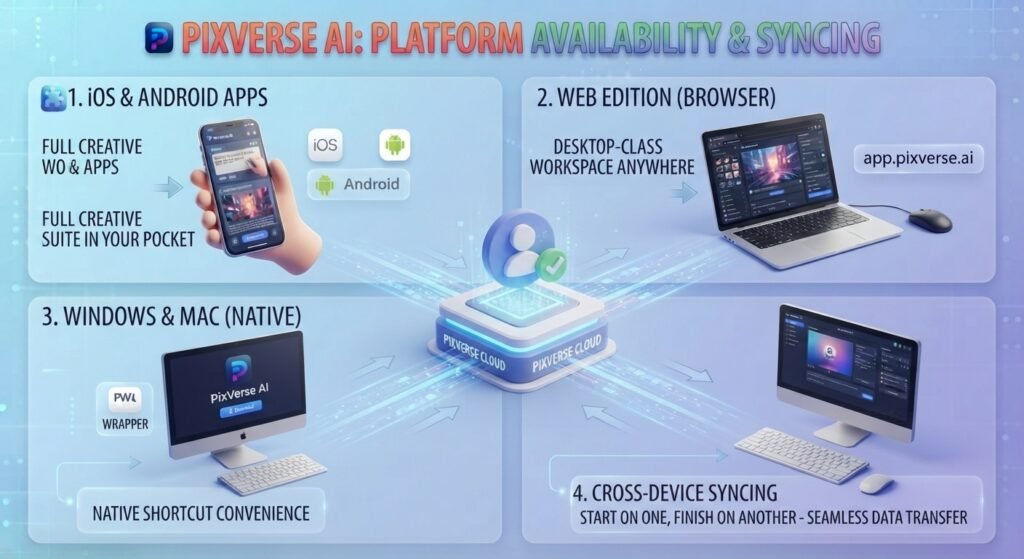
The PixVerse AI software enables users to develop AI films and pictures using a mobile device. PixVerse is accessible on iOS and Android, as well as via a web browser. That makes PixVerse perfect for producers who want to create and modify AI content on the go and on their PC.
1.Is PixVerse AI Available on iOS and Android?
Sure. You may also find the PixVerse AI app on your iOS and Android devices. The mobile app provides users with access to AI video production, picture to video tools, creative effects, templates, and other supporting capabilities.
If you’re seeking for the PixVerse AI app store listing, please use PixVerse’s official app-download site or the Apple App Store or Google Play listing for the respective app store to prevent unauthorized copies.
2.PixVerse AI Web Edition
PixVerse also offers an online version that you may use from a compatible browser without downloading a desktop client. The online platform is especially convenient for users on bigger screens, or generating AI movies from a Windows or Mac computer.
3.PixVerse AI for Windows
PixVerse does not feature a separate official PixVerse AI for Windows desktop software. There is no need to install a separate Windows software for Windows users, since you may utilize the online version of PixVerse in a supported browser.
4.Does PixVers.e AI sync across devices?
The same PixVerse account may be used on both the app and online. When users sign in with the same account, they may access their account-related information and supported creations across devices. That makes it easy to move between mobile and desktop operations without having to set up different accounts.
To put it simply: PixVerse is accessible on Android, iOS, Windows, Mac, and other compatible platforms via the web. The mobile applications are a practical choice if you want to make AI videos on the move.
PixVerse AI Alternatives
Looking for PixVerse AI alternatives? There are several AI video generators that provide comparable text-to-video and image-to-video functionalities. The ideal choice relies on things like video quality, creative control, cost and free use allowance. Here are some of the prominent PixVerse AI rivals and free alternatives to look at.
1.PixVerse AI vs. Runway
Runway is a strong AI video platform with advanced generating and editing features. It’s a powerful alternative for producers wanting more pro video processes and creative flexibility. If you want fast AI video production and creative effects, PixVerse could be a better fit.
2.Kling AI and PixVerse AI
Kling AI is an AI video generator that is popular for its complex settings, lifelike movement, and cinematic-style films. Both systems offer text-to-video and image-to-video processes, however available models and controls may vary. Compare free credits, video quality, and generating restrictions to find the one that matches your workflow.
3.PixVerse AI versus Luma AI
Luma delivers AI video creation that emphasizes realistic motion and creative visual narrative. It is comparable to PixVerse in its capabilities of creating films from text and photos, but the generating features and experience are different. If you’re a creator looking to get more creative generating tools and effects, PixVerse might be helpful.
4.PixVerse AI against Pika
Pika specializes on accessible AI video creation, effects and picture animation. It is among the programs such as PixVerse AI that might be considered for short-form and creative material. Both PixVerse and Pika are aimed at producers who wish to create videos without needing typical editing abilities.
Free PixVerse AI Alternatives.
| Tool | Text-to-Video | Image-to-Video | Free Option | Best For |
| Runway | Yes | Yes | Limited | Professional AI video creation |
| Kling AI | Yes | Yes | Limited | Realistic motion and cinematic videos |
| Luma | Yes | Yes | Limited | Creative video generation |
| Pika | Yes | Yes | Limited | Short-form videos and AI effects |
PixVerse AI Review: Pros and Cons
PixVerse AI helps you produce short AI films from text prompts and pictures easily but the outcomes and the use restrictions depend on the model, settings, and the plan you are on. Here are the key pros and disadvantages to consider before utilizing it.
Pros
AI Video Generation Made Simple:
Create films from text prompts or pictures without extensive editing abilities.
Supports image-to-video
, AI effects, camera controls, and other creative processes with several creative tools.
Great for Short-form Content:
Perfect for social media videos, creative ideas, marketing graphics, and animating images.
Flexible generation options:
Different models and settings may provide more controlled video production.
Free Option:
Users may experience PixVerse AI without the need to buy a subscription package instantly.
Cons
Generation caps:
Free and premium programs have credit restrictions, and the more sophisticated generation may use up credits rapidly.
Results might be hit or miss.
Sometimes complex motions, people, objects and elaborate scenery can give inconsistent results.
AI-generated text may be unreliable:
Text may need to be checked or edited in created videos.
Commercial Use Terms:
Users should verify the latest license terms before utilizing standard material created for commercial purposes.
Some features vary by plan.
Higher resolutions, sophisticated models and other capabilities may need premium access.
Who Should Use PixVerse AI?
PixVerse AI is for anybody who wants to make AI-generated videos without having to know conventional video production abilities. It might be helpful for content production, social media, marketing, product images, and creative tasks.
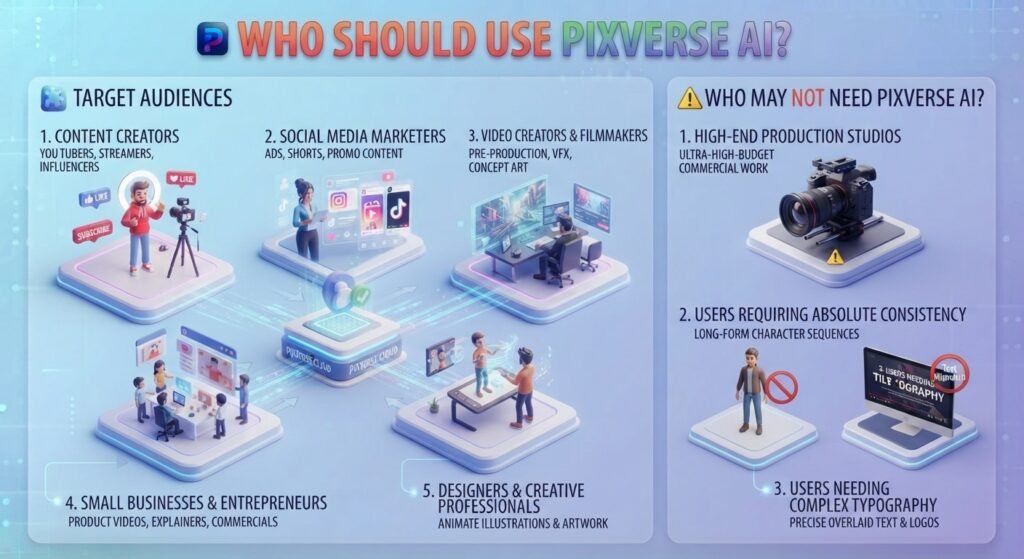
1: Content Creators
PixVerse AI lets content producers transform ideas, prompts and photos into short films for blogs, YouTube, social media and other digital channels. Its AI video technologies may make it faster to create visual content.
2: Social Media Marketers
Social media marketers can generate compelling visual content for Instagram, TikTok, YouTube Shorts, and more social channels using PixVerse. AI-generated clips might be handy to try out new creative ideas and marketing images.
3: Video Creators
PixVerse AI is a tool that helps video artists build scenes, animate pictures, develop visual ideas, or integrate AI-generated snippets to bigger video productions. This may be particularly beneficial for short form or experimental material.
4: Small Businesses
With PixVerse, small companies can create product videos, promotional material, social media posts, marketing images and more, without having to go through the usual video production process for each asset. Businesses should check the license conditions that apply before utilizing material created by PixVerse for commercial purposes.
5: Designers & Creative Professionals
PixVerse allows designers and creative professionals to explore visual concepts, animate artwork, make concept videos, and establish early-stage creative directions. It may be used as a supporting tool instead of replacing a full professional production process.
6: Who May Not Need PixVerse AI?
If you require very accurate video creation, consistent characters throughout complicated situations, professional-grade editing, or full control over every frame, PixVerse AI may not be the best option for you. If that’s the case, you could want a specialist video editor or professional producer.
Frequently Asked Questions